
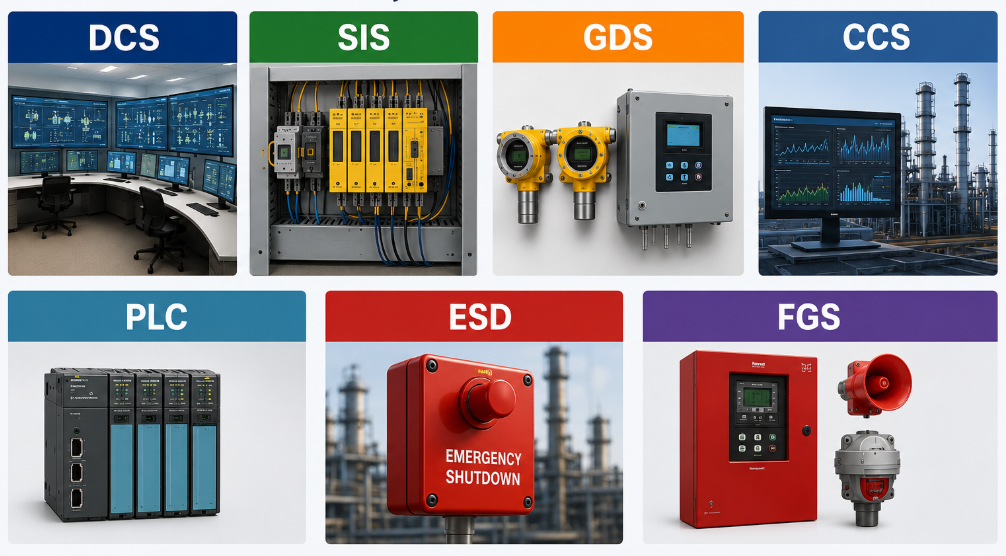
Modern process plants rely on multiple automation and safety systems to keep operations efficient and safe, but acronyms like DCS, SIS, GDS, CCS, PLC, ESD and FGS are often confusing.zeroinstrument+1
To make them easier to understand, we can group them into three categories: core control systems, safety protection systems, and specialized auxiliary systems.
Core Control Systems
These systems are the “brain” of the plant. They handle day‑to‑day process control, sequencing and data acquisition.
DCS – Distributed Control System
A DCS is the main process control platform used in continuous plants such as refineries, chemical plants and power stations.
It adopts a “centralized supervision, distributed control” architecture: control functions are distributed across multiple controllers, while operations, display and monitoring are centralized in the control room.
Typical DCS responsibilities include:
- Continuous process control (PID loops for flow, pressure, level, temperature, etc.).
- Sequence control and interlocks for complex process units.
- Plant‑wide data acquisition and historian logging for analysis and optimization.
With rich built‑in control algorithms, the DCS can manage large amounts of process data and implement complex automation strategies.
PLC – Programmable Logic Controller
A PLC is the basic execution unit in industrial automation and is designed specifically for harsh industrial environments.
It is a digital electronic system that reads sensor inputs, executes a pre‑programmed logic, and drives actuators such as motors, valves or contactors.
PLC systems are widely used for:
- Single‑machine control and packaging lines.
- Discrete manufacturing processes and motion control.
- Serving as local controllers or subsystems within a larger DCS architecture.
A PLC can work independently, or act as a lower‑level control station in a plant DCS, depending on the project’s architecture.
Safety Protection Systems – The “Bodyguards” of the Plant
Safety protection systems are independent layers that protect people, equipment and the environment when something goes wrong.
Under normal conditions they are mostly dormant, but they must respond quickly and reliably when hazardous situations occur.
ESD – Emergency Shutdown System
The Emergency Shutdown System (ESD) is one of the most critical safety layers in a plant.automationforum+1
It is designed to operate independently from the DCS and typically achieves a high Safety Integrity Level (SIL) according to IEC 61508 and IEC 61511.
Key characteristics:
- Normally idle during normal production, not interfering with DCS control.
- When emergencies such as over‑temperature, over‑pressure or leaks are detected, it bypasses the DCS and issues shutdown interlock commands directly.
- Its main purpose is to quickly isolate hazardous energy sources and prevent catastrophic damage to equipment, personnel and the environment.
SIS – Safety Instrumented System
SIS is a broader concept that includes the ESD and other safety interlocks and emergency trip functions.
A Safety Instrumented System is defined as the instrumentation system capable of executing one or more safety functions to reduce process risk to an acceptable level.
In practice:
- SIS logic brings the process to a defined “safe state” when predetermined dangerous conditions are detected.
- It may include multiple subsystems such as ESD, Burner Management System (BMS), and High Integrity Pressure Protection System (HIPPS).
FGS – Fire and Gas System
The Fire and Gas System (FGS) continuously monitors for fires and hazardous gases and operates independently from the process DCS.
It uses smoke detectors, heat and flame detectors, and combustible/toxic gas sensors to detect fire or gas‑leak conditions around the plant.
When danger is detected, the FGS typically:
- Triggers audible and visual alarms to warn personnel.
- Automatically starts firefighting systems such as deluge valves and foam systems, or shuts down fresh‑air and HVAC systems to limit the spread of smoke or gas.
FGS is often considered the last line of defense for consequences that SIS/ESD are designed to prevent.
GDS – Gas Detection System
The Gas Detection System (GDS) focuses specifically on detecting combustible and toxic gas leaks in process units.
It is typically implemented as an important subsystem within the wider FGS, with emphasis on leak detection and early warning.
Main roles:
- Continuous monitoring of gas concentration in high‑risk areas.
- Triggering audible and visual alarms when concentrations exceed thresholds, prompting evacuation or protective actions.
Specialized and Auxiliary Systems – Domain “Experts”
These systems target specific industries or advanced control tasks and often sit on top of or inside the main control platforms.
CCS – Coordination Control System
The Coordination Control System (CCS) is mainly applied in thermal power units.
It treats the boiler, steam turbine and generator as a single integrated unit and coordinates their operating states through advanced control loops.
Core objectives:
- Quickly respond to grid load changes while maintaining stable main steam pressure.
- Enhance the unit’s peak‑shaving and frequency‑regulation capabilities to support grid stability.
In many plants, CCS is implemented as an advanced control strategy or subsystem inside the DCS.
Relationships Between the Core Systems
Understanding how these systems relate to one another is crucial for plant design, integration and safety reviews.
DCS vs SIS / ESD – Normal Operation vs Safety
- The DCS (or Basic Process Control System, BPCS) is responsible for “normal production”: continuous process control, optimization and operator interface.
- SIS and ESD are responsible for “abnormal safety”: they act only when hazardous conditions arise and must be physically and logically independent from the DCS.
This independence ensures that DCS failures or human errors cannot compromise the plant’s safety layers.
FGS vs GDS – Fire and Gas vs Gas‑Only
- FGS is the comprehensive fire‑and‑gas monitoring and mitigation system, covering both fire detection and gas detection plus associated mitigation actions.
- GDS is the dedicated gas‑detection subsystem within FGS, focusing on combustible and toxic gas leaks.
DCS vs PLC – System Platform vs Controller Hardware
- DCS is a plant‑wide control system architecture that provides centralized supervision and distributed control.
- PLCs are the hardware controllers that execute local logic and can be used as building blocks within the DCS or as standalone controllers for specific packages.
CCS – Advanced Strategy Inside DCS
- CCS is typically an advanced control strategy or subsystem implemented inside the DCS in thermal power applications.
- It optimizes the coordinated operation of boiler, turbine and generator in response to grid demands.
Key Takeaways
In a modern plant, DCS and PLC focus on normal process and machine control, keeping operations stable and efficient.
SIS and ESD provide independent safety layers that bring the plant to a safe state when dangerous conditions occur.
FGS and GDS detect fire and gas leaks, trigger alarms and start mitigation actions such as firewater deluge or HVAC shutdown.
CCS is a specialized coordination system used mainly in power plants to manage boiler, turbine and generator as a single, responsive unit.
Together, these systems form a layered architecture—basic control, safety protection, and hazard detection—which is essential for both productivity and safety in high‑risk industries.
Conclusion
Understanding the different roles of DCS, PLC, SIS, ESD, FGS, GDS and CCS is essential for designing safe and efficient industrial plants.
DCS and PLC focus on continuous and discrete process control, while SIS and ESD provide independent safety layers that act only when dangerous conditions occur.
FGS and GDS handle fire and gas detection and mitigation, and CCS delivers coordinated control in power‑generation applications.
When these systems are properly separated yet well‑integrated, plants can achieve high productivity without compromising safety or regulatory compliance.