
In industrial temperature measurement, “Pt100” is often treated as a single concept, but in practice there are at least two incompatible Pt100 standards: the IEC 60751 Pt100 and the GOST 6651-2009 Pt100 used in Russian and CIS equipment. They share the same basic measuring range and a minimum span of 10 K, but differ in standard system, temperature coefficient α, resistance-temperature curve and instrument compatibility.
This article explains the key differences and then gives practical selection advice for replacement sensors and projects.
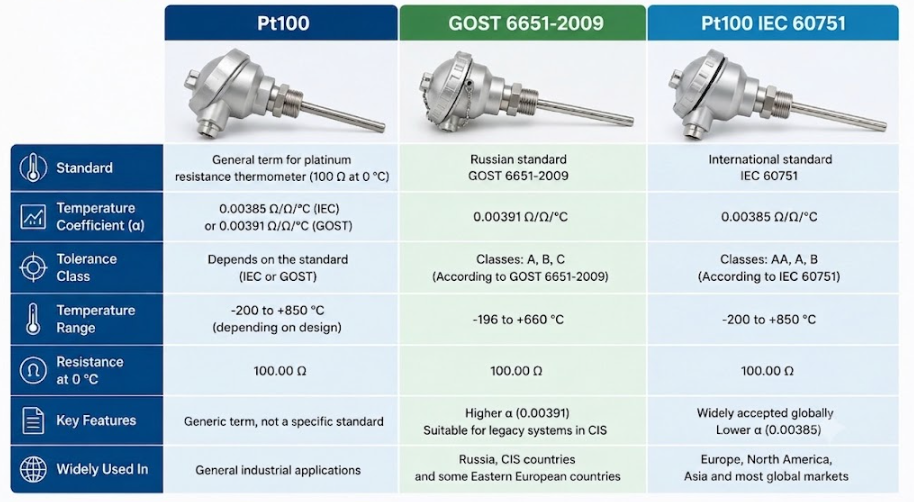
Different Standard Systems
There are two main Pt100 standards behind the same “100 Ω at 0 °C” concept:
- Pt100 GOST 6651-2009, α = 0.003910
Russian national standard for resistance temperature detectors, used on Soviet and CIS equipment. It follows a traditional high-purity platinum characteristic curve, commonly called the “391 curve”. - Pt100 IEC 60751, α = 0.00385
International electrotechnical standard adopted by the EU, China and most countries worldwide. It is commonly called the “385 curve” and is the global mainstream for industrial instruments.
Different α Temperature Coefficients
The temperature coefficient α describes the average change in resistance per degree between 0 °C and 100 °C:
α = (R100 – R0) / (R0 × 100)
- IEC 60751 Pt100: α ≈ 0.00385
The standard resistance at 100 °C is 138.51 Ω, meaning the resistance increases by about 0.3851 Ω per degree over 0–100 °C. - GOST 6651-2009 Pt100: α = 0.003910
The standard resistance at 100 °C is 139.10 Ω, so the resistance increases by about 0.3910 Ω per degree over 0–100 °C.
Although both sensors are 100 Ω at 0 °C, their resistance values diverge rapidly as temperature rises.
Different Platinum Material Concepts and Curves
The difference in α originates from different platinum material concepts and calibration curves:
- IEC 60751 (385 curve)
Designed around doped industrial platinum to fit the ITS-90 temperature scale, using the standard Callendar–Van Dusen polynomial for its resistance-temperature relationship. - GOST 6651-2009 (391 curve)
Originated from earlier high-purity platinum wire with a naturally higher temperature coefficient, using its own resistance tables and calibration constants that are not interchangeable with IEC equations.
In practice, you cannot mix the polynomial constants from IEC 60751 with the resistance table for GOST 6651-2009; each belongs to its own standard family.
Same 0 °C Resistance, Different Values at Higher Temperatures
Both sensors are defined as Pt100, so at 0 °C their resistance is exactly 100 Ω. However, at 100 °C and above, their resistance values are noticeably different, and this directly creates large temperature errors if you mix sensors and instruments.
In practical terms:
- A 391-curve probe (GOST 6651-2009) connected to a 385-curve instrument (IEC 60751) will read significantly higher than the true temperature.
- A 385-curve probe connected to a 391-curve instrument will read significantly lower than the true temperature.
For typical process ranges, the error can quickly reach tens of degrees Celsius, so the two curves are not interchangeable in real plant operation.
Different Application Scenarios and Instrument Ecosystems
Because the standards and curves are different, each Pt100 type is “native” to a different equipment ecosystem:
- IEC 60751, α = 0.00385
Used across Chinese, European, American and Japanese equipment. PLCs, temperature controllers, paperless recorders and RTD transmitters are almost always based on the IEC 385 curve by default, and most industrial temperature instruments in these markets assume IEC 60751. - GOST 6651-2009, α = 0.003910
Mainly used on Russian, Belarusian and Kazakh industrial equipment, especially older boilers, chemical and metallurgical installations. Only instruments designed for Russian and CIS standards support the 391 curve; typical international temperature controllers do not offer this option.
In other words, the sensor and instrument must belong to the same curve family to be compatible.
Subtle Differences in Additional Technical Requirements
Both standards specify a nominal operating range of −200 °C to +850 °C and a minimum measurement span of 10 K, but they differ in how they define accuracy and test methods:
- IEC 60751
Specifies accuracy classes AA, A and B, self-heating limits, AC measurement properties and insulation requirements, providing a unified quality-control framework globally. - GOST 6651-2009
Uses Russian-style test procedures, tolerance definitions and ageing requirements aligned with the CIS metrology system.
Practical Selection and Usage Advice
To avoid hidden measurement errors in real projects, it is essential to match the sensor curve with the instrument curve.
- Do not mix 385 and 391 curves
The probe and the instrument curve must match exactly; 0.00385 and 0.00391 Pt100 curves cannot be swapped without reconfiguring or recalibrating the instrument. - Domestic and international projects
For domestic Chinese projects and imported European, American or Japanese equipment, always choose Pt100 according to IEC 60751 with α = 0.00385. - Russian and CIS legacy equipment
For older Russian and CIS machines and plants, the correct choice is Pt100 according to GOST 6651-2009 with α = 0.003910. - Use instruments with curve selection
If the instrument supports curve selection in its parameters, you can switch between 385 and 391 profiles to adapt to the installed sensor instead of changing hardware.
Conclusion
Although both Pt100 IEC 60751 and Pt100 GOST 6651-2009 share the same nominal resistance at 0 °C and similar operating ranges, their temperature coefficients and resistance curves are fundamentally different. Mixing a 385-curve sensor with a 391-curve instrument (or vice versa) can create large hidden temperature errors and process risks.
For safe and accurate temperature measurement, always confirm which Pt100 standard your instruments use, and keep sensors and instruments on the same curve. When in doubt, consult a specialist to verify compatibility and select the right Pt100 type for your project.